Galapagos ISLANDS

birthplace of Darwin’s theory.

The Galápagos Islands are an archipelago of volcanic islands. They are distributed on each side of the equator in the Pacific Ocean, located 906 km west of continental Ecuador. They are known for their large number of endemic species that were studied by Charles Darwin during the second voyage of HMS Beagle. His observations and collections contributed to the inception of Darwin's theory of evolution by means of natural selection.


Photos is the gallery were taken during my four last trips to the island (2010-11-14-16), as a results I got the chance to visit twice the Northern and the Southern part of the Archipelago.
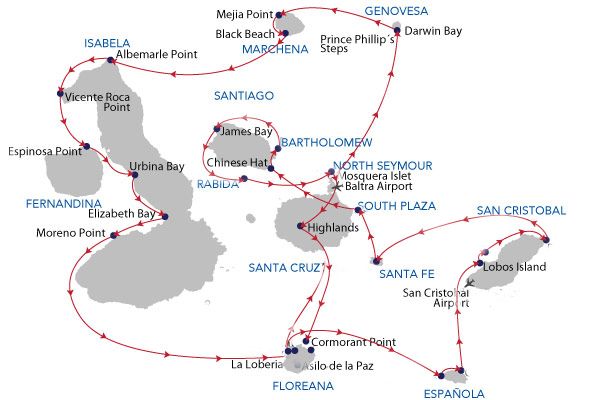
Detailed travel route map of the Galapagos Islands showing multiple stop points and destinations.
Two seagull silhouettes standing on rocky shore against sparkling ocean background.
Dramatic orange sunset with full sun visible through clouds over dark waterfront landscape.
Baby seabird chick with fluffy gray feathers perched on rocky cliff ledge.
Close-up of a marine iguana resting on black volcanic rocks in the Galapagos Islands.
A young sea lion rests on sandy beach surrounded by dark volcanic rocks in the Galapagos Islands.
Close-up view of a pale gecko lizard against a textured brown surface.
Close-up profile of a sea lion's head showing its distinctive whiskers against a blue sky.
Fossilized remains of an ancient creature embedded in rocky terrain.
Group of waved albatrosses nesting together on rocky ground.
Albatross soaring in flight against blue sky and dry grass landscape.
Albatross gliding low over dark rocky cliffs near ocean waves.
Silhouette of a bird soaring against a cloudy winter sky.
Close-up portrait of a waved albatross with its distinctive yellow beak.
Bald eagle flying over brush against bright blue sky.
A colorful marine iguana with distinctive pink and turquoise coloring rests on volcanic ground in the Galapagos.